
Crawl space dehumidifier installation in Raleigh, NC
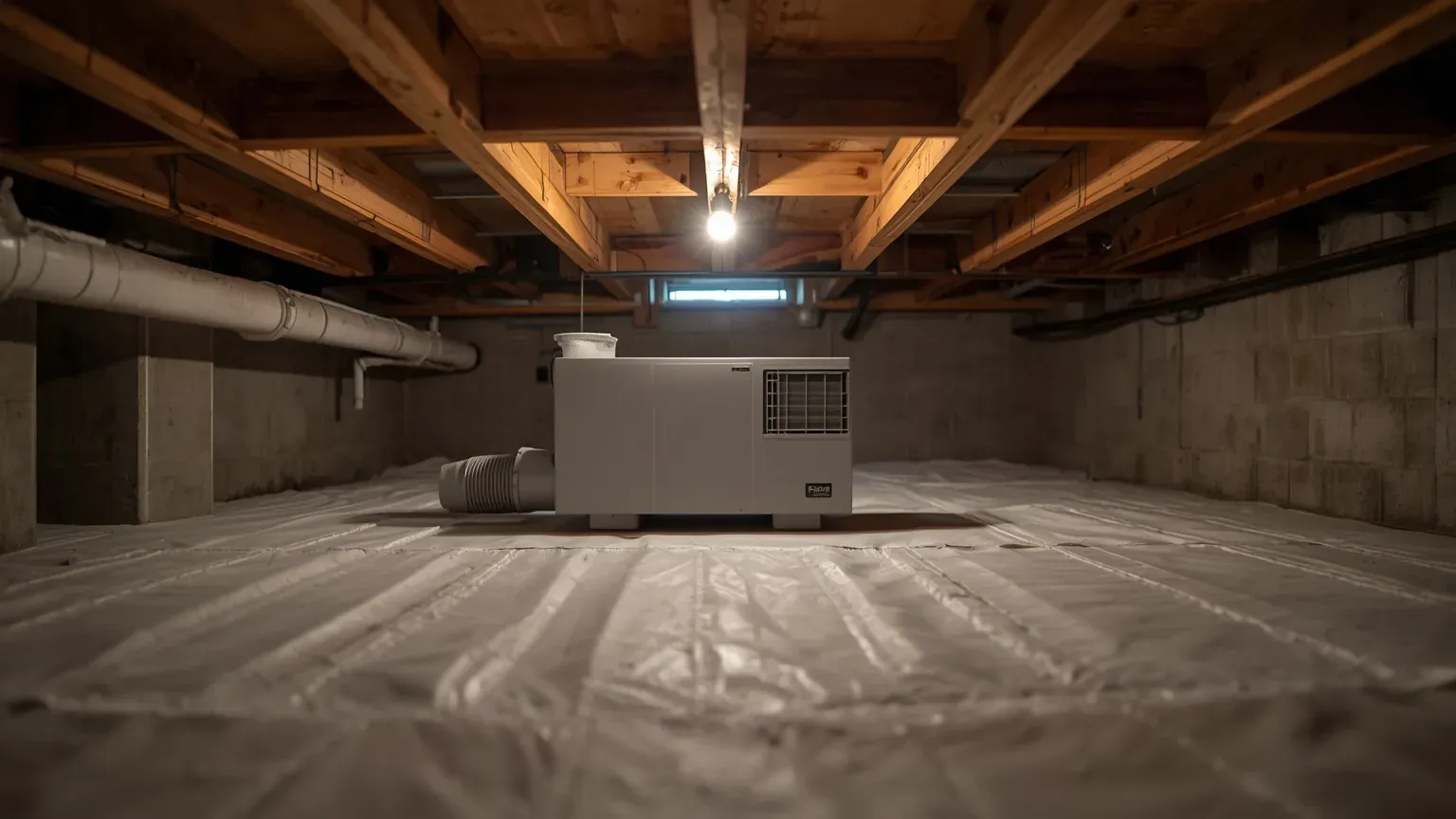
A crawl space dehumidifier is a permanently installed, drained appliance sized to the space — not a portable unit on the dirt with an extension cord. North Carolina code treats it as one of several acceptable ways to satisfy the drying requirement in a closed crawl space, and it only works once the space is actually closed.
Who handles crawl space dehumidifier installation in Raleigh, NC?
Raleigh Crawl Space Solutions arranges crawl space dehumidifier installation across Raleigh and Wake County — capacity sizing, permanent condensate drainage, placement and the dedicated circuit the NC Electrical Code requires. Call (919) 746-7020 to arrange an evaluation.
Why it comes last, not first
A dehumidifier removes water from air. It does nothing about water arriving as liquid, and in a vented crawl space it is working against the outdoors — humid air keeps coming in through the vents, and the unit runs continuously trying to dry Wake County.
That is why installing one into an unsealed, wet crawl space produces high running costs and disappointing results, and why it is one of the more common wasted purchases in this trade.
The order that works is: stop liquid water, cover the ground, seal the space, then dry what remains. Once the space is closed the job becomes finite and a correctly sized unit can hold it.
What NC code actually requires
R409.5 requires a closed crawl space to have a mechanical means of drying, and a dehumidifier is one of the accepted options — but not the only one.
The code recognizes a dehumidifier rated at a minimum of 15 pints per day, a conditioned air supply from the HVAC system at 1 CFM per 30 square feet of crawl space floor, an exhaust fan at 1 CFM per 50 square feet, or a house air fan at the same rate. Which is appropriate depends on the house — the ductwork layout, whether the system can spare the air, and how the sealed space behaves once closed.
Two things follow. A sealed crawl space with no drying method at all is an incomplete installation under North Carolina code. And a contractor who presents a dehumidifier as the only lawful option is not describing the code accurately.
What proper installation involves
Sizing to the actual volume and remaining moisture load of the space rather than to whatever the supplier stocks. An undersized unit runs constantly and never reaches its set point; an oversized one short-cycles.
A permanent condensate drain so the unit empties itself — gravity to a suitable discharge point, or a condensate pump where gravity is not available. A unit that has to be emptied by hand is a chore that gets forgotten, and it quietly stops removing anything the first time the tank fills.
A dedicated electrical circuit. Adding one is electrical work under the NC Electrical Code and carries its own permit requirement regardless of the size of the wider project — worth confirming who is pulling it.
And placement that lets the unit circulate air through the whole space rather than dry one corner, with clearance left for filter changes and service.
Portable units, and why they disappoint
A household portable dehumidifier is designed for a bedroom or the corner of a basement. In a crawl space it faces a harsher environment, needs its reservoir emptied by hand, and generally cannot hold a target humidity across the volume of a full crawl space.
If someone has recommended a dehumidifier for your crawl space, establish which kind is meant. The permanently installed, drained appliance and the one on a home improvement shelf are different products at different prices, and only one of them satisfies R409.5.
What the code expects of a Raleigh installation
A sealed crawl space in North Carolina has to have a means of drying the air, and a dehumidifier is one of several ways to satisfy that — not the only one, and not automatically the cheapest to run.
The part homeowners are most often surprised by is the electrical work. A dedicated circuit is its own permitted item under the NC Electrical Code, independent of the size of the encapsulation project it sits inside, and it is a common exclusion from an otherwise complete-looking quote.
Crawl Space Dehumidifier Installation questions
What size dehumidifier does a crawl space need in NC?
R409.5 sets 15 pints per day as the minimum capacity where a dehumidifier is the chosen drying method, but the minimum is a floor rather than a specification. Correct sizing follows from the volume of the space, how well it has been sealed and how much moisture load remains after drainage and liner work — an undersized unit never reaches its target and an oversized one cycles inefficiently.
Do I have to use a dehumidifier in a sealed crawl space?
You have to use something. NC code requires a mechanical means of drying, and a dehumidifier is one accepted option alongside a conditioned air supply at 1 CFM per 30 square feet, an exhaust fan at 1 CFM per 50 square feet, or a house air fan at the same rate. The right choice depends on your HVAC layout and how the space behaves once sealed.
Does a crawl space dehumidifier need its own circuit?
Generally yes, and adding one is electrical work under the NC Electrical Code with its own permit requirement, independent of the size of the encapsulation project around it. Ask whether the electrical work and permit are inside the quoted price or excluded from it.
How much does it cost to run?
It depends on the unit's efficiency, how well the crawl space was sealed and how humid the summer is — a well-sealed space gives the unit a finite job and it runs far less than one fighting open vents. Anyone quoting a precise monthly figure before seeing your crawl space is guessing. The larger variable is the quality of the sealing, not the appliance.
Can I just leave a portable dehumidifier down there?
It rarely works. Portables need manual emptying, are not built for crawl space conditions, and generally cannot maintain a set humidity across the volume of the space. They also do not satisfy the drying requirement for a closed crawl space under NC code.
Related crawl space services
Find out what is actually causing it.
Someone under the house, moisture readings taken, and the scope written down before a price is attached.