
Crawl space drainage systems in Raleigh, NC
Drainage gives water somewhere to go that is not under your house. It is the part of crawl space work that gets skipped most often, because it is less visible than a bright new liner and harder to photograph — and it is the part everything else depends on.
Who handles crawl space drainage in Raleigh, NC?
Raleigh Crawl Space Solutions arranges crawl space drainage across Raleigh and the Triangle — grading and discharge correction, exterior interception and interior perimeter systems, specified to where water is actually entering. Call (919) 746-7020 to arrange an evaluation.
Start above ground
Before anyone excavates, the surface water should be dealt with, because it is cheaper and because it is frequently the whole problem.
A roof sheds a substantial volume of water in a Raleigh storm, and in a 46-inch rainfall year that adds up. Where downspouts discharge within a few feet of the foundation, that water goes straight down against the footing. Extending discharge properly away from the house is the highest-return work in this entire category.
Grading is the companion issue. Ground should fall away from the house, and over the years it stops doing so — beds built up against the foundation, mulch added annually, backfill settling. Re-establishing that fall solves more crawl space water problems than most homeowners would believe.
Exterior drainage
Where surface correction is not sufficient, exterior drainage intercepts water before it reaches the foundation — typically a perforated line in a gravel bed at the footing, wrapped in filter fabric and routed to daylight or a suitable discharge.
It is the more thorough approach, because it treats the water where it originates rather than after it has arrived. It is also the more disruptive and expensive one, since it involves excavating around the foundation, and in Piedmont clay that excavation is real work.
It is worth knowing that filter fabric and correct bedding are what determine whether the system still functions in a decade. A drain line packed directly into clay silts up and stops draining.
Interior perimeter drainage
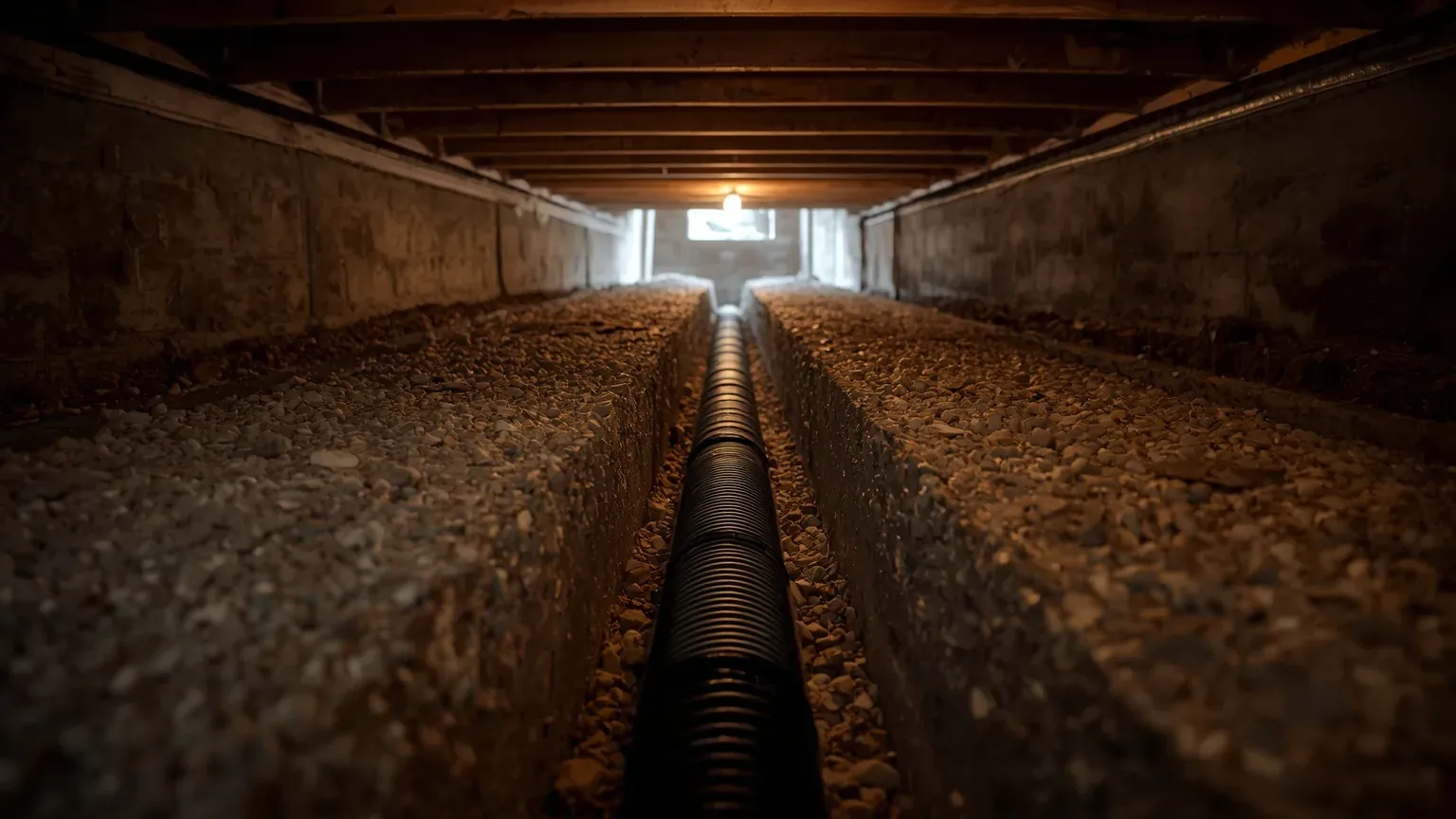
An interior system runs a collection line inside the crawl space perimeter, below grade, feeding a gravity discharge or a sump.
It accepts that some water will reach the space and manages it rather than excluding it. That makes it the practical option where exterior excavation is blocked by a driveway, a patio, mature planting or a neighboring structure — or where the water is genuinely groundwater rising rather than surface water arriving.
It is often paired with a sump where the site has no gravity fall available, which is common on flatter lots.
Where the water goes
Discharge is the part that gets underspecified, and a drainage system is only as good as its outlet.
It needs a route to somewhere the water genuinely leaves — daylight at a lower elevation, or an appropriate storm connection where one is permitted. Discharging a few feet from the foundation returns the water to the soil beside the house, where it works its way back.
In Piedmont clay this matters more than on sandy soils, because the water will not simply percolate away at the discharge point. It needs fall and distance.
Roof water is the biggest single variable in Wake County
In a 46-inch rainfall year an average roof sheds tens of thousands of gallons, and every downspout decides where that volume goes. Discharging within a few feet of the foundation puts it straight down against the footing, where Piedmont clay will not disperse it quickly.
This is why drainage work should always start above ground. Extending discharge and re-establishing fall away from the house is cheap, reversible, and frequently resolves the problem that an excavation was being quoted for.
Crawl Space Drainage questions
Do I need drainage or just a vapor barrier?
It depends on whether you have liquid water or ground vapor. A barrier stops evaporation from bare earth; it does nothing about water arriving as liquid, which runs over the top of it or collects beneath. If water appears during or after rain, that is a drainage question and it comes first.
How long does a crawl space drainage system last?
The determining factor is whether it was bedded and filtered correctly. A perforated line in a properly sized gravel bed wrapped in filter fabric keeps working for a long time; a line laid straight into Piedmont clay silts up and stops draining, sometimes within a few years. The specification matters more than the brand of pipe.
Can drainage be installed without digging up my yard?
Interior perimeter drainage is installed inside the crawl space and avoids exterior excavation, which is why it is chosen where a driveway, patio or mature planting makes digging impractical. It manages water that reaches the space rather than intercepting it beforehand, so which approach fits depends on where the water is coming from.
Does a French drain help a crawl space?
It can, where the problem is surface or shallow subsurface water moving toward the house — that is essentially what an exterior interception line is. It is not a universal answer, and a drain installed without establishing where the water enters is as likely to miss the path as catch it.
Related crawl space services
Find out what is actually causing it.
Someone under the house, moisture readings taken, and the scope written down before a price is attached.