
Crawl space vapor barrier installation in Raleigh, NC
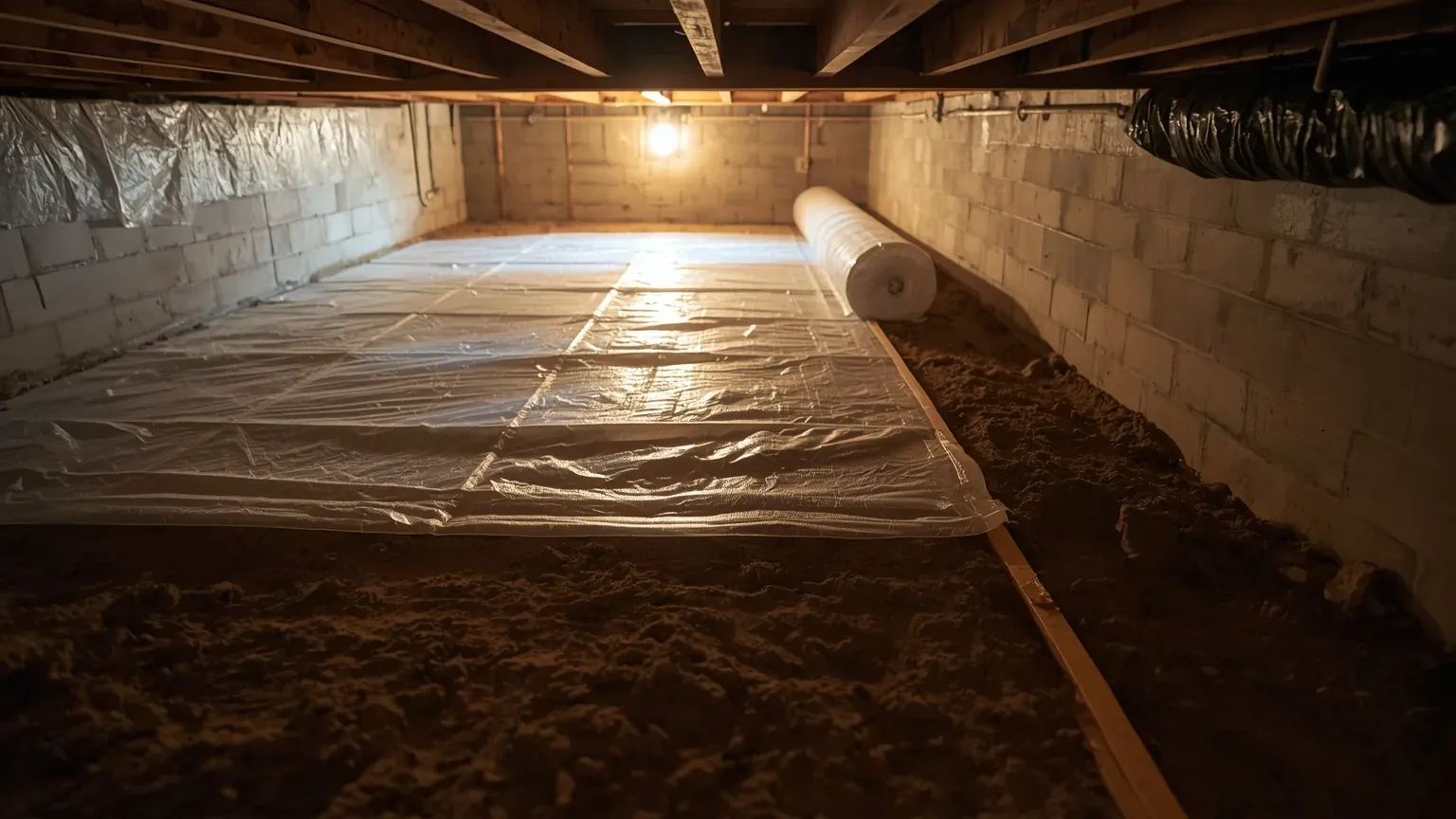
A vapor barrier covers the ground so soil moisture stops evaporating into the crawl space. It is a smaller job than encapsulation and, in a genuinely dry crawl space, sometimes the correct one. The mistake is treating the two as interchangeable when they address different sources of water.
Who handles crawl space vapor barrier in Raleigh, NC?
Raleigh Crawl Space Solutions arranges crawl space vapor barrier installation across Raleigh and Wake County — Class I liner over exposed earth, lapped and sealed seams, and an honest assessment of whether a barrier alone is sufficient for your crawl space. Call (919) 746-7020 to arrange an evaluation.
What a vapor barrier does, and what it does not
Bare earth under a house evaporates moisture continuously into the air above it, even when the ground looks dry to the eye. A vapor barrier is a sheet laid over that earth to stop the transfer.
That is the entire job. It does not seal the vents, so humid outdoor air keeps arriving. It does not manage the humidity of the space. It does not stop liquid water entering through the walls or up through the ground — water simply runs over the top of it or collects beneath it.
Understanding that boundary is what stops a homeowner buying the wrong scope. A barrier addresses one moisture source out of three.
The specification North Carolina sets
Even as a standalone measure, the material spec is worth holding to the closed crawl space standard in NC Residential Code R409, because it is the published benchmark and installers here already work to it.
That means a Class I vapor retarder at 6-mil polyethylene minimum over all exposed earth, seams lapped not less than 12 inches, and the liner carried at least 6 inches up the foundation walls. Many installers use heavier liner — 10, 12 or 20-mil reinforced products — which resists puncture from anyone later working under the house.
Where liner is taken further up the walls, the 3-inch termite inspection gap under R409.2.2.1 applies just as it does in a full encapsulation. A barrier is not an excuse to bury the foundation wall.
When a barrier is genuinely enough
When the crawl space is dry. Framing measuring in a normal moisture range, no standing water, no condensation staining on ductwork, no fungal growth, no odor reaching the house — that is an assembly that is working, and covering the ground is a reasonable improvement rather than a rescue.
It is also a sensible first step when budget is genuinely constrained and the moisture problem is mild, provided nobody is telling you it will solve a condensation problem it cannot reach.
Where it falls short is the mechanism that dominates a Raleigh summer: warm outdoor air arriving through open vents and condensing on surfaces below its dew point. That water is arriving as air, and a sheet on the ground does not touch it.
Barrier or encapsulation — how to decide
The deciding question is which moisture source dominates in your crawl space, and that is a measurement rather than a preference.
If ground evaporation is the main source and the space is otherwise dry and reasonably isolated from outside air, a well-installed barrier may be all the situation calls for. If humidity in the space tracks the outdoor humidity through the summer — the pattern Advanced Energy documented in vented North Carolina crawl spaces, frequently above 80 percent relative humidity through the cooling season — then the vents are the larger source and sealing the ground alone will disappoint you.
And if there is liquid water, neither is the first move. Drainage comes before any liner goes down.
Why bare ground matters so much on Piedmont clay
Cecil clay holds moisture. Exposed earth in a Wake County crawl space evaporates into the space above it continuously, and unlike a roof leak there is no event to notice — it simply runs, every day, in every season.
That is the specific problem a ground liner solves, and it is why covering the earth is worth doing even where the crawl space has never held standing water. What it will not do is address air arriving through the vents, which in this climate is usually the larger share.
Crawl Space Vapor Barrier questions
What thickness vapor barrier does NC code require?
The closed crawl space standard in R409 sets a Class I vapor retarder at 6-mil polyethylene as the minimum over exposed earth, with seams lapped at least 12 inches and the liner carried at least 6 inches up the foundation walls. Heavier reinforced liners are widely used and resist puncture better, but 6-mil is the code floor.
What is the difference between a vapor barrier and encapsulation?
No. A barrier covers the ground. Encapsulation covers the ground, seals the vents and rim joists so outside air stops entering, and then actively manages the humidity of the sealed space with a mechanical drying method. Encapsulation costs more because it addresses more moisture sources.
Can I install a vapor barrier myself?
Physically it is achievable in an accessible crawl space, and some homeowners do. What is harder to do well is detailing — lapping and sealing seams properly, fitting around piers and penetrations, and keeping the termite inspection gap correct where liner runs up the walls. It is also worth knowing what you are treating before you cover the ground, because a barrier laid over a space that is taking on liquid water hides the problem rather than fixing it.
How long does a vapor barrier last?
The material itself is durable; what shortens its life is traffic. Anyone crawling under the house to service ductwork or plumbing can tear a light liner, which is the main argument for a heavier reinforced product. Worth inspecting occasionally rather than assuming it is intact.
Related crawl space services
Find out what is actually causing it.
Someone under the house, moisture readings taken, and the scope written down before a price is attached.